In 1903, the Wright brothers took their first flight. In that same year, a twenty-eight-year-old attractive and flamboyant Harriet Quimby moved to New York City seeking adventure. She gained employment as a reporter for Leslie’s Illustrated Weekly. Harriet seemed to relish living on the edge of the new inventions of the day, like driving a car. She would travel around looking for fascinating stories to write about for Leslie’s. Harriet was eventually given the assignment of being a theatre critic. Her looks and charisma allowed her to fit easily into the top echelon of the young, rich, and famous of the day.
In 1911, she met an aviator. She convinced him to teach her how to fly from a flying school on Long Island. She became the first woman to receive such instruction and became the first woman to receive a pilot’s license in August of that year. Flying one of the early airplanes was one of the deadliest occupations/hobbies of the day. The pilots were of the most idolized adventurers. Beauty, charm, charisma, and daring made Harriet a sensational superstar. Using her fashion sense, she created a purple satin jumpsuit with a matching hat to wear as she traveled around the country demonstrating the wonders of aviation.
In 1912, she became the first woman to fly across the English Channel. She was just the second person to complete such a feat. Early on April 16, Harriet took off from Dover, England, and visibility depreciated to near zero in a cold mist. Fuel running low, she was forced to land on the beach near Calas, France, some ten miles from where her admirers waited. This feat would have put her picture on the front page of every newspaper in the world except for one other event that took place twenty-four hours earlier, the Titanic sinking. As a result, her daring accomplishment was relegated to a small column on page three. Her fame was overshadowed before she enjoyed the first bit of her achievement of becoming “America’s First Lady of Flight.”
Ten weeks later, Harriet’s flying carrier would end, as well as her life. On July 1, during a flying exhibition, the event manager joined her in a flight over Boston Harbor. Those in attendance were horrified as they watched the plane make several abrupt movements up and down, first throwing the passenger out and then Harriet into the harbor five hundred feet below. Seatbelts had not yet been made part of the flying machine.
I first read about Harriet Quimby in the Smithsonian Magazine. You might do well to read more about her extraordinary life. ( http://www.nationalaviation.org/our-enshrinees/quimby-harriet/)
I do not give you this introduction to Harriet Quimby as a role model. I just found her life thought-provoking and fodder for thinking about the events of my life. One of the first thoughts and most consequential was the importance of wearing a seatbelt! You, too, have probably felt the deflation of having a personal best achievement minimized by the people around you and their preoccupation with things other than what is central to you.
In the living of your New Life, you likely have had more than a few spiritual highs and successes. Never take a wonderful moment as proof you are ready for all challenges. Just because you have taken off and landed a thousand times does not mean that the next take-off or landing will be guaranteed. Guard against letting a new insight or accomplishment, given you by the Holy Spirit, be an affirmation of reaching sufficient maturity to face any challenge. Life is too fragile and chaotic and broken to assume you have mastered living.
Contemporary life on our planet is more fragile than the flying machines of the first decade of aviation. There will never be a day, this side of heaven, that a Believer, any Believer, will not be dependent upon the Breath of God continually flowing in and out of their lungs. There is simply no life outside of His life.
He satisfies you with good things;
your youth is renewed like the eagle.
Psalm 103:5 CSB
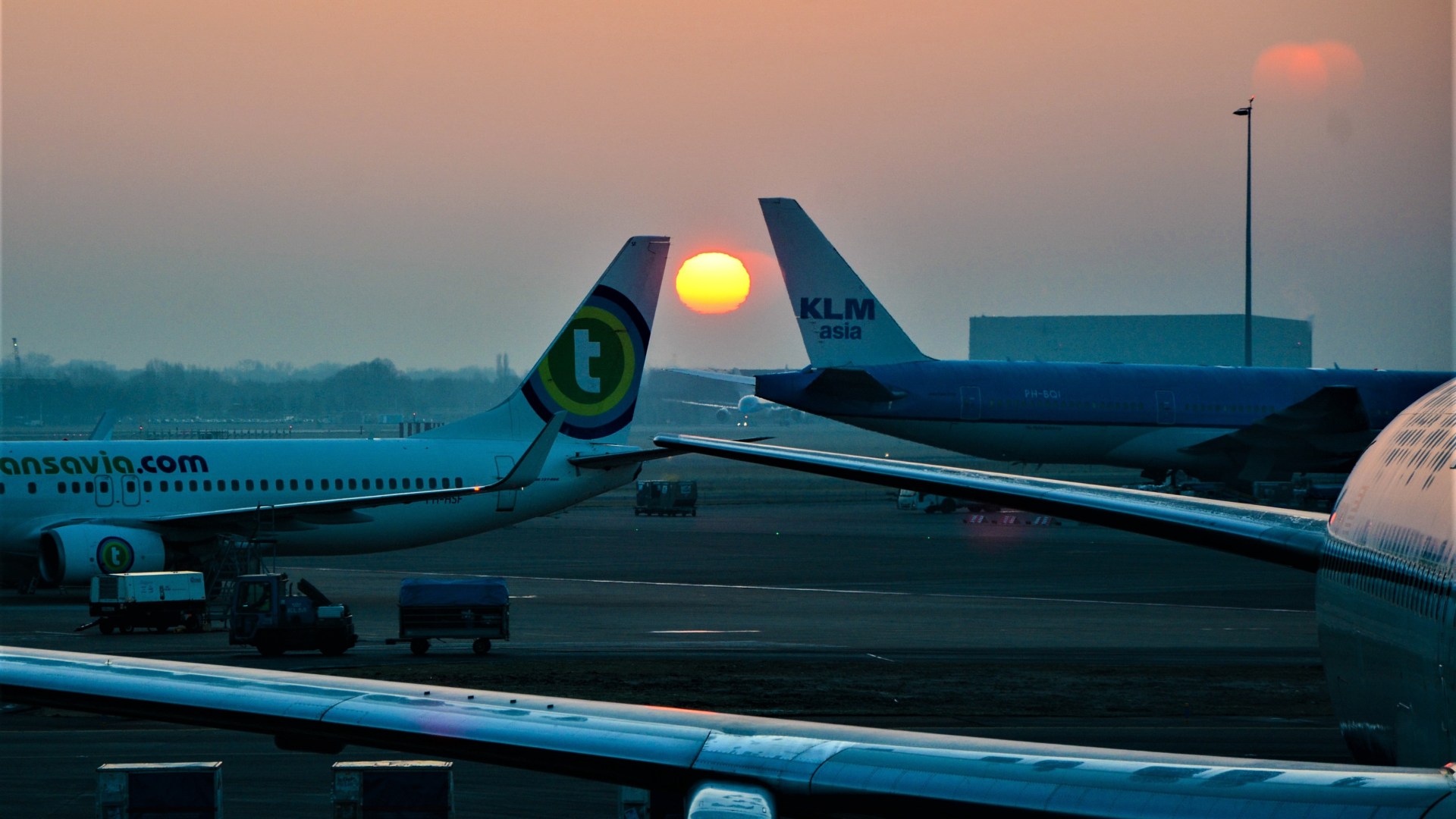
Photo – Sunrise at the airport in Amsterdam, Netherlands.
 Baldwin Heirlooms