I am slowly pondering my way through Psalm 32. The promise from God recorded in the eighth and ninth verses has motivated the exploration of this Psalm of King David. If you choose to read on, you might discover something for yourself as you consider the musings of my history and God’s will.
I do not believe the earth is flat. Flat insinuates that our home planet has a “disk” shape and thus has an edge. Beyond the earth-disk edge is nothingness or oblivion.
However, the flat earth theory reasonably describes my intellectual abilities. We each have limits on what we comprehend easily and what is nearing incomprehension. I do not think these edges of our cognitive skills necessarily limit our abilities, but they force us to develop strategies to compensate for our genetic deviations.
Our natural abilities and disabilities can be a source of incredible frustration and destruction of our view of ourselves as positive contributors to our families and society’s advancement. I first discovered the “edge” of my cognitive abilities in High School. When handed the little red grammar textbook, I did not realize the book was a weapon of self-destruction. It was the smallest of my textbooks by width and height, but oh, the unfathomable insanity of its content.
My memory tells me that we started with sentence punctuation. I understood what to put at the end of a sentence. Dividing up a sentence with commas, colons, semicolons, and such was bewildering to me. Still are. But I do manage it. But when we began to diagram sentences, my mind was overwhelmed with the information. Words like transitive and intransitive were not a part of my vocabulary.
Nouns, pronouns, adjectives, articles, adverbs, verbs (nonaction and action), and conjunctions were introjections into my thinking patterns that were no more understandable than the vocal sounds making up a foreign language. I had no physical, everyday life categories to draw similarities for comprehension or associations. Those words were, and are today, abstractions. Overwhelmed, I decided I was stupid, and with my yet-to-be-developed work ethic, I just checked out and strove to survive.
I developed a love of learning somewhere in or around my academic staggering. In addition, I discovered that I am a visual learner. Unfortunately, the educational theories that guided public schools at that time differed from those implemented today for students with similar intellectual strengths. As a result, I was considered one of the “slow” ones.
Stories and experiences are the best way for me to find comprehension. But, unfortunately, grammar does not yield itself to being learned by either. As a result, my academic history is marked more by near misses and do-overs than by triumphs. Nevertheless, I am pretty proud of what I have achieved academically. Not in a sinful way, but in a “look-at-what-God-has-overcome” way.
I don’t think I learned to study until I was in the Southern Baptist Theological Seminary doctoral program. That is when I discovered the joy of learning. After that, I developed the necessary research and critical thinking skills to feed my hunger to learn.
So, I understand that I am not a towering example of “smarts.” But that doesn’t matter. What matters is that God challenged me, equipped me uniquely, and gave me a great environment to discover the joy of learning new things and discovering new depths in old things. He also put brilliant people among my closest friends. In high school, it was Tommy and Lois. The second Divine grace was upon me when He gave me to Jan.
I will instruct you and show you the way to go;
with my eye on you, I will give counsel.
Do not be like a horse or mule,
without understanding,
that must be controlled with bit and bridle
or else it will not come near you. (Psalm 32:8-9 CSB)
A final thought for today. My opinion, with which I wholly agree, is that most Christians want God to send them abundant blessings of security, success, and peace without submitting to or accepting the challenge of becoming His student wholeheartedly.
Just one more “final” thought, this from Romans 12:3, “Do not think of yourself more highly than you should.” (Or lowlier, or just more than you should.)
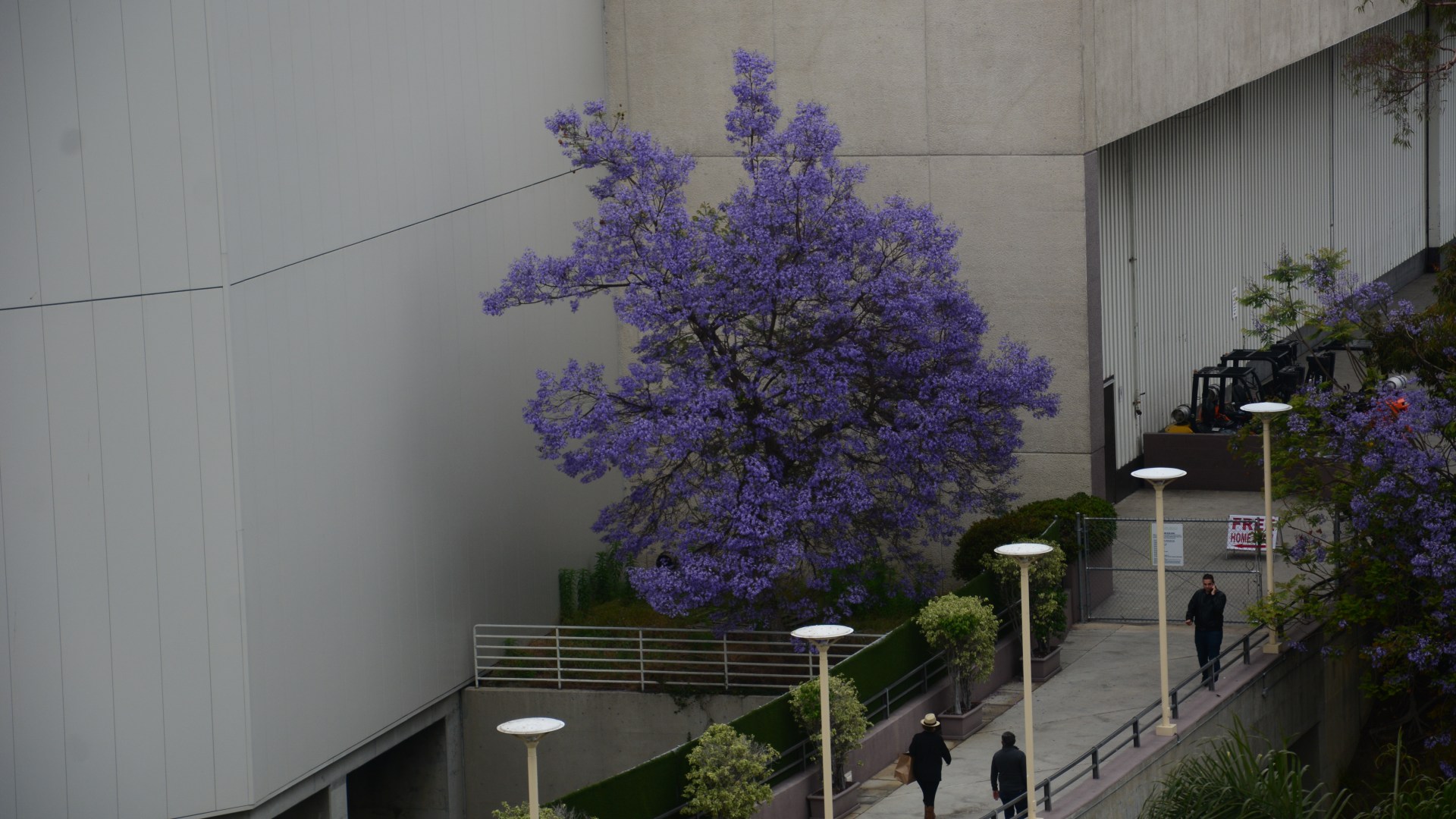
Photo – Magnificent tree outside our hotel window when visiting Long Beach, California. A wonderful collection of shapes, textures, and colors.
 Baldwin Heirlooms