
hen you went on your Gulf Coast vacation, you had to cross Highway 90 to get to the beach. It runs from New Orleans across the panhandle of Florida. As Highway 90 leaves New Orleans, it is named the Chef Menteur Highway. As it heads east, it cuts under Lake Pontchartrain and rides a narrow strip of land and marshes. On the strip is where the Deningers built their house. I think it was on Jacobs Drive, the first house on the left. Their house was built on stilts and had a slip under it for their little fishing boat.
The Deningers loved us and were part of Ridge Memorial Baptist Church. I was their rookie pastor. We were fortunate to eat regularly around their table. On one of our visits to their house, I noticed their boat was out of the water, bottom side up, resting on two sawhorses.
I was told the boat was in “dry dock” for maintenance. The boat did not leak, nor did it have any damage. The maintenance involved removing the barnacles. Wikipedia says, “Barnacles are arthropods of the subclass Cirripedia in the subphylum Crustacea. They are related to crabs and lobsters…. Barnacles are economically significant as biofouling on ships, where they cause hydrodynamic drag, reducing efficiency.”
Mr. Dininger was removing the sea critters that were slowing his boat down, making steering sluggish, and wasting fuel. Barnacles cannot be simply wiped off. They have securely fastened themselves to the boat. Each one had to be persuaded by a steel scraper.
As my body has aged, my epidermis has acquired quite a collection of “barnacles.” I hate them. My exterior makes my interior feel ugly. I don’t know where they came from or when they arrived. But I digress….
Or maybe that is the launch point for this pondering. Like the Deningers’ boat, our lives accumulate barnacles as we merrily go about our daily activities. WE don’t know it at the time or even care. They are those little, almost innocent, thoughts that we allow to cast a momentary shadow across the bow of our moral and ethical ship. We may not notice the weight of the little crustacean critter hanging around. But when enough of those little almost innocent thoughts gather on our unseen side of life, our moral willpower is slowly, mercilessly impacted. On the top side, on our daily excursions over the deep waters, we don’t foresee the pending peril we are sailing into. We keep our eyes on the sky searching for some sign of a coming storm. We see none, so we sail on, assured that those tiny, submerged clingers are not affecting the day’s freedom.
We often don’t know where those spiritual crustations came from or when they arrived. We certainly didn’t set out to cause spiritual drag, sluggish responses, or wasted energy. Our spiritual life becomes laborious. The temptation is to “live with it” as the way life is.
After all, we can’t see the barnacles, nor can anyone else. Our boat looks, for all intents and purposes, to be seaworthy. We can’t see them, so we can tell ourselves all is well, and this is just the way the Christian walk is. We ask God in every prayer to “forgive us our many sins,” though we can’t think of any by name. But then we really don’t ask for them to be revealed. What we hear ourselves pray is “forgive us our many sins,” but what God hears is “forgive us our mini sins.” Mini in number and in gravity.
Most of our sinful acts are out of conscience’s sight, below the waterline of our ego. We have gotten used to them. The “economic biofouling” no longer feels significant. In fact, it has become our norm. Any disturbance to our level of contentment is seen as spiritual hypersensitivity and is downplayed as “just emotions.”
We are good people, no leaks, no damage that can be easily seen. That confidence keeps the differences between being the “image” of God and being a good churchgoer hidden below our daily waterline, out of sight, out of mind.
Keeping our spiritual routine stable is proof enough that all is well between our God and us. All the while, our lack of spiritual influence is insignificant and, worse, unnoticed. Unnoticed by us, but not by the humans who live around us. We establish relationships in our human environment that keep our boat from rocking too much. And the “deviants” around us are just that, deviants from the norm. We are confident that we are the poster child of being a normal Christian.
That brings me back to dry dock. That is what our daily devotional time is all about: to get our little boat out of the water, upside down on the Word, and allow the Holy Spirit to scrape our hull clean of all the accumulated spiritual barnacles.
Such a radical action is not pain-free or convenient. But if we want to experience the daily wonder of a personal encounter with our Creator God, it is essential.
Psalm 26:2 does not say, “I have examined myself, O God, and have not found any significant divergences between what you want and what I want.”
This is the way the Voice translation presents that verse of the Psalm as a prayer:
“Put me on trial and examine me, O Eternal One! Search me through and through – from my deepest longings to every thought that crosses my mind.”
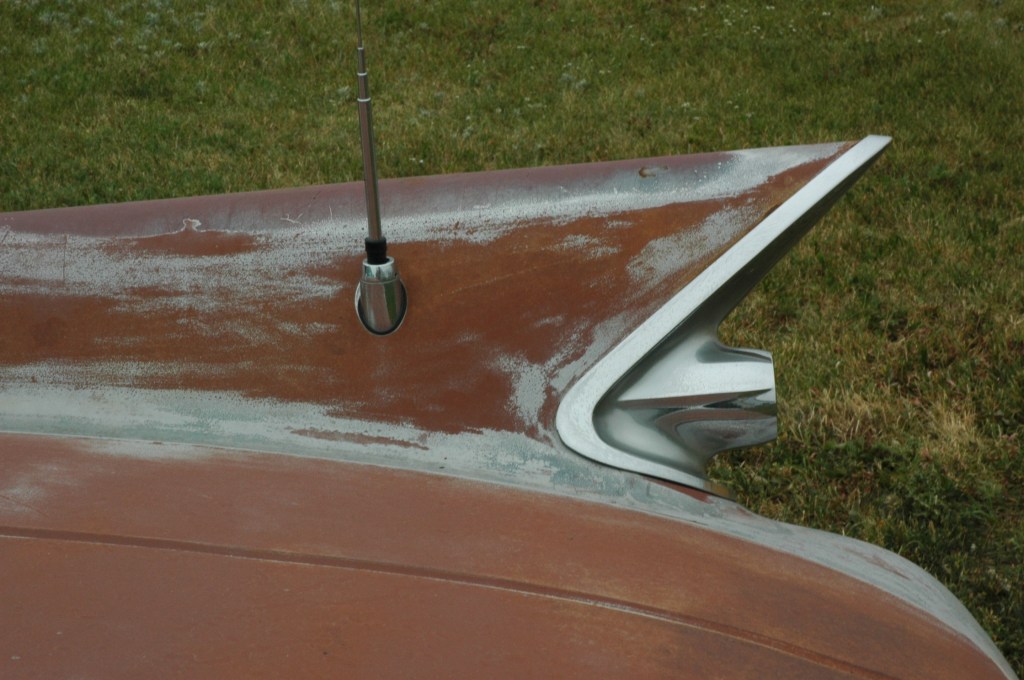
Photo – The tailfin of a Chrysler New Yorker. From the size of the fin I’m guessing late 1950s. I took the photo in Farmington, Montana while on a mission trip a few years ago.

