Faith: A place to stand in unbearable circumstances.
A vista from which to see the wonder of the Kingdom’s coming.
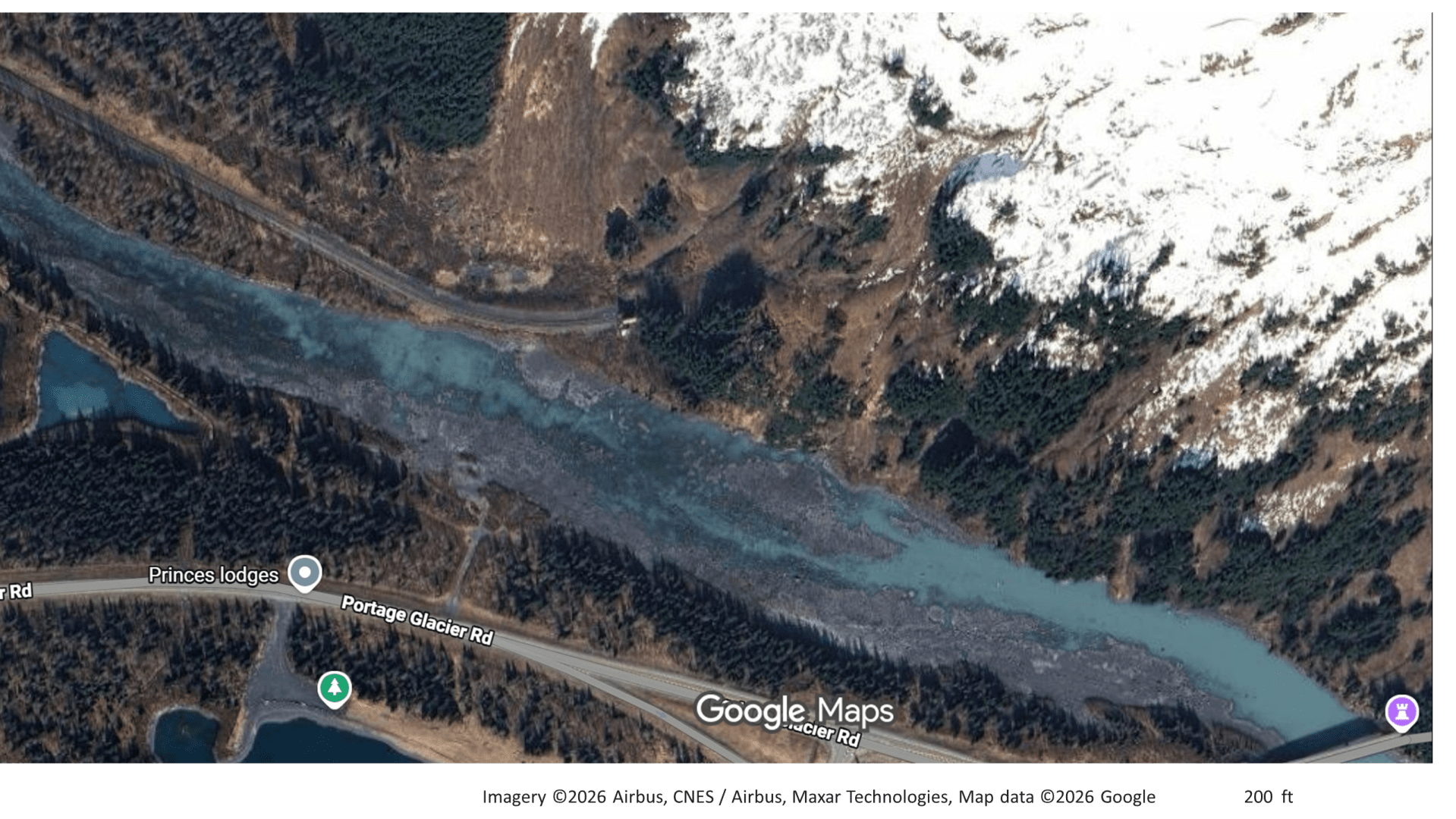
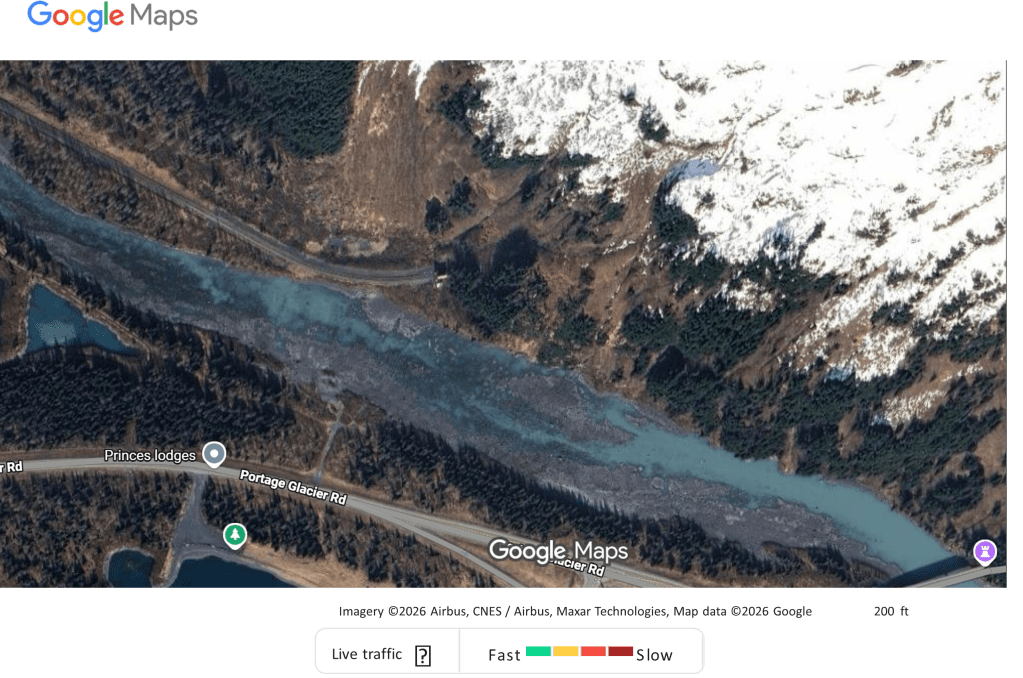
60,78935°* N 148.86034° W Those are the coordinates of extraordinary pain, marking one of my misadventures while stationed in Alaska during the summer of 1970. (The picture below is the approximate location of this misadventure.)
Take Alaska Highway 1 south out of Anchorage, and you will have a beautiful drive along the east edge of Turnagain Arm of Cook Inlet. At the bottom of Turnagain Arm is Portage, or it was Portage. As a result of the March 28, 1964, “Good Friday,” 5:47 P.M., earthquake, Portage sank into the silt when the bottom of the arm rose. When I was there, only a couple of wooden structures stood stuck in the sticky gray goop up to their window sills. Portage is still on the map, but it is no longer a populated community.
When I was there, Portage was where you drove your car upon a flatbed railroad car to be transported to Whittier. A boat was the only other way to get personal transportation to that city. The boat took weeks, whereas the train took a couple of hours.
Seven miles from Portage, the railroad passed through a tunnel that was just a mile long. Coming out of the tunnel and crossing a wide, flat valley, it began a journey through another tunnel before arriving at Whittier.
Between the tunnels was a flat valley. On the map I had it was named, “Bear Valley.” With visions of a black bear rug on my wall, I read Bear Valley, and I was hooked; there was no need to research the area. My mind formed an instant image of black bears lighting up before me, each holding a sign that read, “I want to be on your wall.”
Paul B. went with me to bag my bear; surely Bear Valley would have my trophy. To get to the valley, we would have to walk through the mile-long tunnel. (Yes, what you suspect did in fact take place.)
To hike to the tunnel was seven miles from Hwy 1. That was too far. We opted to cross Portage Glacier River which separated the road to the glacier from the railroad to Whittier. It was not very deep, but it did move fast. Did I mention that the point where we decided to cross Portage Glacier River was just below where it flowed out of the Portage Glacier Lake, which was within the line of sight of the Portage Glacier? I clearly remember chunks of ice from the glacier floating past. Glacier water is not clear; it is filled with the blue gray sediment from the rocks ground to dust by the glacier’s slow downhill movement.
I took off my boots and socks, rolled up my pants legs as far as possible, hoisted my guns and gear over my head, and stepped into the water. It was certainly cold, but my vision of a bear rug pushed me probably ten feet further. The pain was unbearable. The only recourse was to stand one foot on top of the other on a round rock, forming a six-inch-diameter island.
I turned to look at Paul. He asked, “Is it cold?” To which I yelled, “No man! Come on over!” Paul never got his second foot in the water. He had no vision of a bear rug on his wall!
I stood there wobbling on one foot as long as I could. Then I tried my best to walk on top of the water as fast as I could back to the bank. It took several minutes for my feet to stop hurting and just feel the cold.
We then decided that seven miles was not too far to hike after all. There are at least three other chapters in this gripping hunting story. And several life lessons I can draw upon from just this much of the story. You’re smart enough to do the same. But let me share with you what brought this vision to mind this morning.
This year, 2026, I am slowly thinking and researching my way through Paul’s letter, which we call Ephesians. In my fourth month, I am still digesting the first chapter. And I am still grinding away in the first fourteen verses. Not because it is hard to understand, but the deeper I go, the deeper its gravitational pull is on my desire to know. I do find it hard to replace my old platitudinous understanding with new insights.
One of the helps for me is to keep a vocabulary of words that catch my curiosity. I will often keep the vocabulary open on my Microsoft Surface while reading the passage on my iPad. This story interrupted my reading with the word “faithful.”
Here is my insight: When life gets painfully cold, the knowledge of God we have acquired thus far is the rock on which we can stand for relief, hope, and peace. Faith does not make the water warmer or the distance we must navigate shorter. Faith is the place where we regroup from our crisis of hope before plunging back into the narrow gate and difficult road. What my life has taught me is that the deeper my knowledge of God and His way, the more the impact of my faith on this “Pilgrim’s Progress.”
Now faith is the reality of what is hoped for, the proof of what is not seen. (Hebrews 11:1, CSB, emphasis is mine.)

