
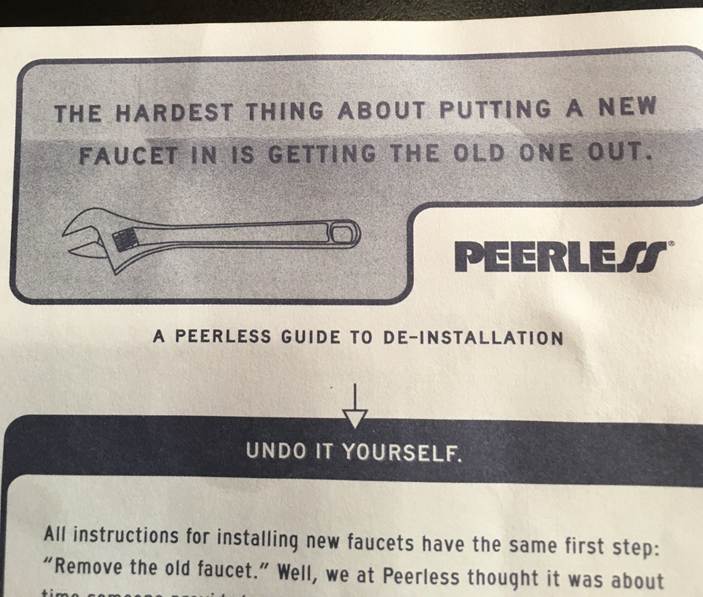
I’m still undecided on the title of this blog post. I also like “Undo It Yourself” as an alternative.
This picture is of the side of the box that our new kitchen faucet came in. It’s a true statement. Removing the original malfunctioning faucet is a cumbersome pain. Putting the new one in isn’t much less painful. Thankfully, changing faucets is seldom necessary. That thankfulness is countered by the fact that the plumbing skill cannot be developed.
I found the statement on the box not only true about replacing faucets, but also true for adjusting anything about us. At least it is for me. From physical issues like eating habits to motivational issues like getting in or out of bed, or psychic issues, like rusty old shame memories and insignificance sinkholes. It is hard to change what we have come to accept as a less-than-ideal lifestyle based on a sort of sluggish cohabitation with our personal demons.
There is a nasty old saying, “You can’t teach an old dog new tricks.” The new trick is not the problem: it’s giving up, or even modifying, the old tricks that we have relied on. They tend to develop leaks over time. As we age (not necessarily mature), the law of diminishing returns sets in, but we keep on keeping on. Lowering expectations is easier to adjust to than changing our “that’s just the way I am” mindset. Old ways are deeply ingrained in our problem-solving, satisfaction, and defense mechanisms that may not have worked well, but at least have gotten us this far.
For every good life change you desire to make, there is a bad life habit that must be modified. More than modified, mortified, and eliminated! Modified bad habits are still bad habits. Destructive thinking cannot be transformed into less destructive. A merciless annihilation must take place. Towels are not very effective if you are still standing in the running shower. Wet towels aren’t good for much of anything. They will become a limiting, cumbersome obstacle, neither assisting with cleanliness nor redressing, nor offering any warmth. Just the same as a bad habit.
Speaking of “habit,” did you know the original meaning of ” habit ” was “clothing”? Today that meaning only appears when talking about a “nun’s” or “monk’s habit” or, less often, a “riding habit.” Over the centuries, it came to mean “bearing, conduct, or behavior.” Eventually, it came to mean a repeated activity: “a behavior pattern acquired by frequent repetition.”
Intentionally or unintentionally, we become what we practice and repeat. Our habits are good things if they help us achieve a healthy lifestyle. They are detrimental to a healthy lifestyle when and where they impede our maturity and adaptation to our environment, physical, mental, spiritual, and/or communal.
The good thing about habits is that they save us time by not requiring us to respond to every opportunity we encounter individually.
They become bad things when tolerated or leaned on to hide us from overcoming the temptations of physical, mental, spiritual, and/or communal growth.
Desires of the heart and distractions of the mind reveal the quality of our habits. Pay close attention to those revelations! They are like a compass directing us either to a healthy relationship with God or to a deadly relationship away from God. Our habits must evolve with the movement of the Holy Spirit as He uses our study of the Bible, involvement in a local church, and soul meditation.
So, when the faucet you use for life is faulty (corrupt), follow the instructions on the “box” and be patient and determined. Be careful when creating your habits, and remember it’s harder to get the old habit out than to get the new one in.


Fred, I thought this post was especially brilliant and helpful!
LikeLike