
“Our Father … but, if you do not forgive others …”
There is a modified trinity in the Prayer: God, Me, the people around me. Modified in the sense that I have a relationship with people that God is very adamant about caring for. That modification is the number of individuals in the “people” includes myself, the people I know, those I don’t know, those I like, and those whom I find offensive.
To this point, the Lord’s Prayer has been primarily about my integrity, connecting the purpose for which God created me with the decisions I make about how to most efficiently navigate daily choices and circumstances. It also has a sub-motivation to acknowledge my physical dependency upon the goodness of God’s generous supply of substance. I am, you are, every human is, dependent upon God’s provisions that make life sustainable. It’s been about me and mine.
There is also in me a self-securing desire for God to dissolve the threats that lurk about in the shadows of my mind, as well as those lurking about in the minds of the people around me. I must also include the insecurities of past idiotic opinions and behavior of my past that haunt me. Then there are the idiotic concepts governing the opinions and behavior of the hostile natives lurking in the forest surrounding my monolithic commune.
In short, I have used this prayer taught by Jesus to improve my life and then, after I’m secure, to improve the lives of the people I love. Only now am I learning, but not quite fully adapting to, the truth that Jesus’ prayer is about God, the Creator, the Father, working to improve the lives of the people He loves.
Only to the extent of my willingness to assimilate my being totally into the purposes of God, am I useful to Him. Yes! God loves me, but that love is not like human love. Human love is measured out to improve the life of the individual doing the loving. Thus, human love is fickle and reactive. God’s love, on the other hand, is driven by His purpose to demonstrate His magnificent organic Glory.
I am created in His image, which means that when a person, or God Himself, looks at me, He should be able to clearly identify His presence in His creation. Not my presence in the world.
The front bookend establishes how my relationship with God is supposed to look and function. He is Father, I am His child. The back bookend establishes how my relationship with each other human is supposed to look and function.
My dependence upon God’s provision. The protection from my lower human nature.
Just as God, the Creator Father, seeks to destroy the gap between Creator and created. First, God gave His Son, Jesus, to make a reconnection with humanity possible, and His reason for doing it. I am to follow His example. Second, God gave His adopted son, Fred, to continue that reconnection between Creator and created.
When we pray what we call the “Lord’s Prayer,” we are acknowledging and prioritizing our attitudes and worldview around the Creator’s purposes for creation.
So we are ambassadors for Christ, as though God were making His appeal through us; we [as Christ’s representatives] plead with you on behalf of Christ to be reconciled to God. (2 Corinthians 5:20, Amplified Bible)
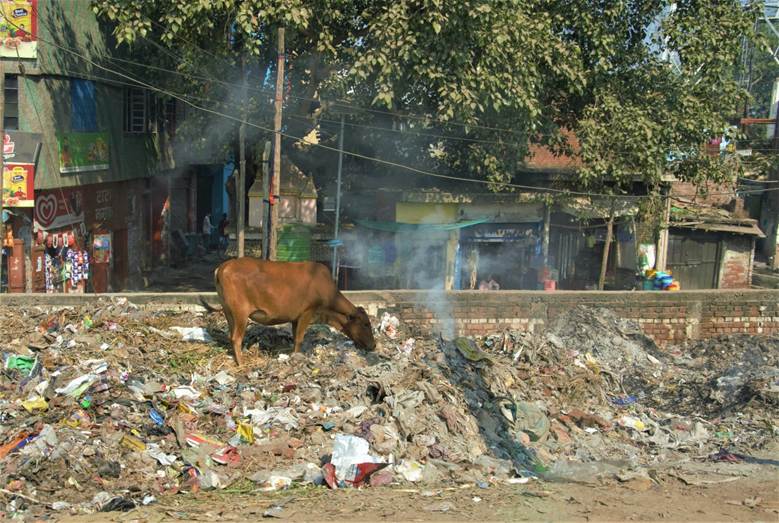
Photo – Taken in India. A free-range sacred cow on a not-so-sacred smoldering trash pile, which was leaning against a major business avenue divider.
 Baldwin Heirlooms
A truly needed attitude and priorities adjustment!
LikeLike